About Zhao Jiajing
Spatial music composer and interdisciplinary sound artist
空间音乐作曲家 · 跨学科声音艺术家
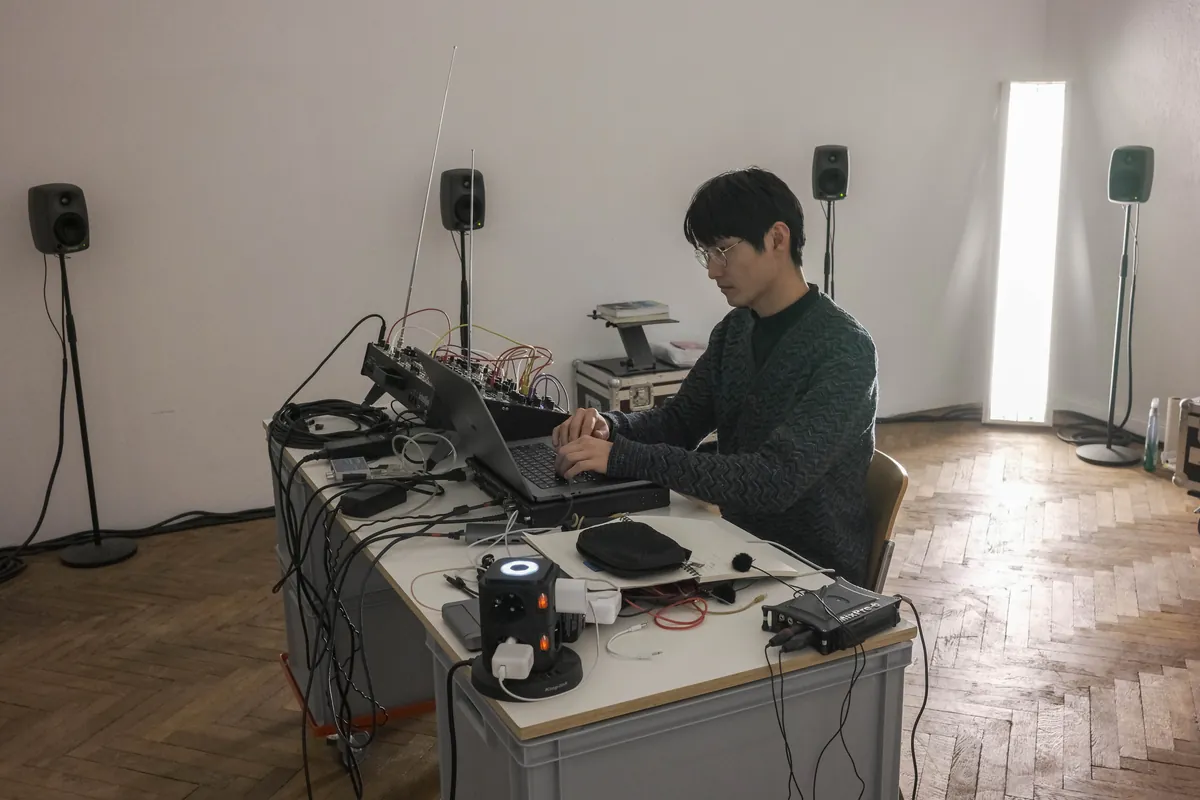
Zhao Jiajing (赵嘉旌; surname Zhao) is a spatial music composer and interdisciplinary sound artist working across electroacoustic composition, live performance, installation and new media art. Through sound, space and creative technology, he transforms concepts into sensory worlds.
His research moves between bodies of water, infrastructures, more-than-human senses, time and scale. Works often begin in fieldwork, recording and conceptual research, and are composed with a deliberate liquidity that lets each site reshape them. Space is the central concern of his compositional practice: he works with the scale, position and motion of sounds, and with spatial dramaturgy and perspective, to articulate artistic ideas. The technology he employs changes with every project, found, adapted or built to meet each work’s conceptual and aesthetic needs. Sustained interdisciplinary exchange with scientists, engineers, visual artists and theatre-makers extends this process: their questions, data, methods and laboratory phenomena become references and starting points for new work.
His composition FOMO was selected to represent the ISCM British Section at the 2026 ISCM World New Music Days. His work has been presented by Ars Electronica, IRCAM, ZKM Karlsruhe, ICMC, GMEM, SICMF and ORF musikprotokoll, with recognition and commissions from Musica Nova, Musicacoustica, the Shanghai International Arts Festival, Computer Space and Aesthetica.
Zhao holds an MA in Information Experience Design from the Royal College of Art and is pursuing a PhD at CRiSAP, University of the Arts London, on ecological approaches to spatial music experience. He has taught as a visiting lecturer at University College London.
Selected CV → · Full CV available upon request via email.
Statement
Every sound carries its own space. A sound can feel vast or tiny, close or distant, even before I decide where to place it. Composing lets me play with that sense of scale and imagine different positions from which to listen. Being surrounded by sound can feel intimate, protective or overwhelming. I spend time listening for these differences.
Within these spaces, listening often becomes tactile and visual for me. A resonance can feel almost touchable; a familiar sound can suggest a place, a movement or someone’s presence. I am drawn to how these impressions can grow into a world around me. Through my work, I try to give thoughts and feelings this kind of sensory life, leaving room for others to find their own associations.
Technology lets me listen to things I would otherwise miss. A hydrophone picks up sounds beneath the water; an electromagnetic pickup makes electrical activity audible. Each device also leaves its own traces in the recording. These devices change what I can hear, but I still listen with a human body and imagination. The recordings offer a starting point for imagining how an unfamiliar world might feel.
Working with scientists, artists and engineers introduces questions I would not arrive at alone. I want to understand what excites them and what they are still trying to work out. An unfamiliar method or material can change the direction of a piece. Sometimes I return to a work after months or years and hear it differently. I value the moments when making something causes me to reconsider the idea I began with.
Curiosity is what keeps me making work. Some pieces grow from the pressures I experience around attention, surveillance and time. Others begin with something that surprises or delights me. Oceans, caves, radio telescopes and microscopic worlds change my sense of how large things are, how far away, or how long they last. They make me wonder how much escapes my perception. With each work, I like to try something unfamiliar—a recording method, a tool, a way of listening. That sense of discovery matters to me as much as finding a way to express something I already know.